
AI automation for smoother business processes

Repeated data entry, searching for information and preparing the same reports take time your team could spend on customers and more demanding work. Nemis helps review business processes, simplify their steps and introduce automation and AI where they offer a useful improvement.

We work with businesses in Gorenjska and Ljubljana, remotely or on site by arrangement. We begin with one clearly defined process, an agreed outcome and a responsible person.

Where does everyday work lose time?

We first assess how work actually happens: where requests come from, which data is needed, who makes decisions and where delays, errors or duplication arise. A clearer process provides the foundation for useful automation.

MANUAL WORK

Data is copied between systems

The same orders, contacts or document details are entered repeatedly into spreadsheets, business applications and reports.

COORDINATION

Enquiries have no clear route

Emails, attachments and requests are assigned manually, making it difficult to see what has been handled and who should act next.

INFORMATION

Knowledge is scattered

Instructions, answers and documents are held in different folders or by individual people. Finding the right information takes too many steps.

What we can improve together

We select a process with sufficiently clear inputs, repeatable steps and a measurable result. Rules and data transfers use conventional automation; AI can help with text processing, classification and drafts where appropriate.
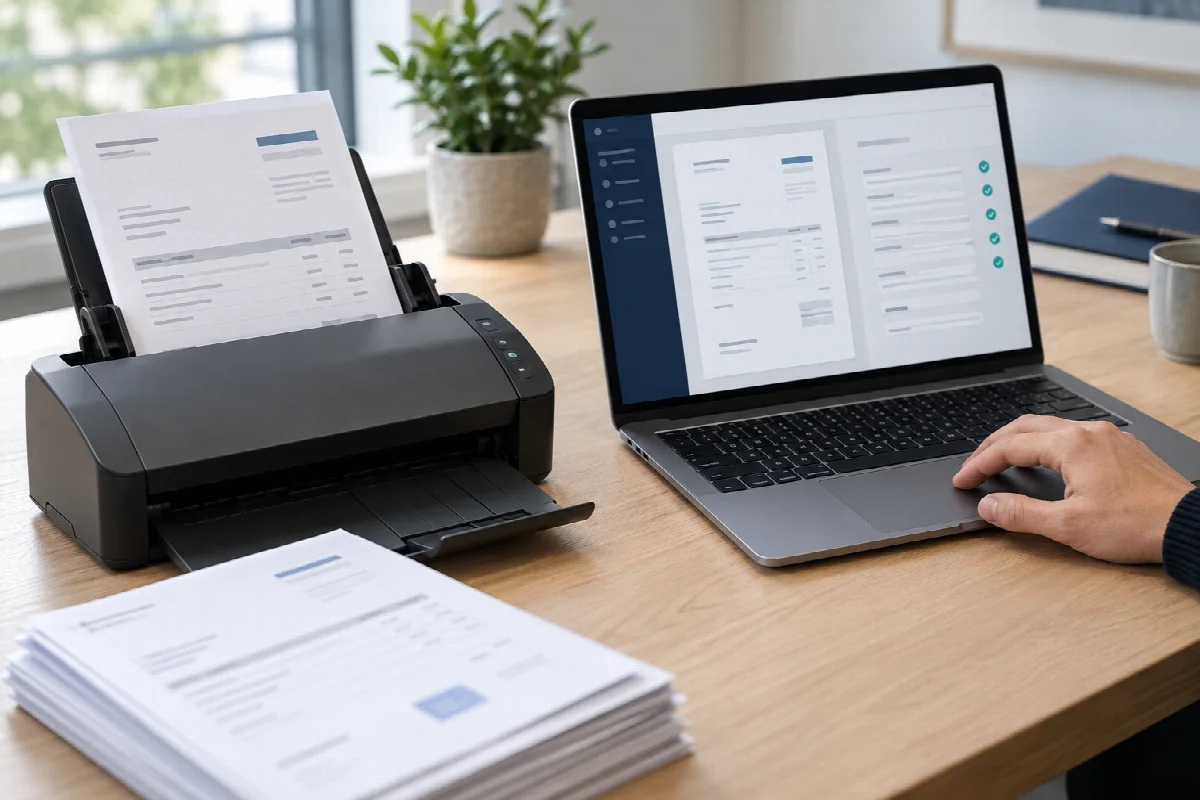
Scanning a business document and reviewing extracted data on a laptop
DOCUMENTS

Document capture and processing

Extracting agreed fields from forms, orders, invoices or other documents. Required-field checks and a route for manual exception handling come before writing to the destination system.

COMMUNICATION

Emails and enquiries

Classifying requests, summarising longer messages, assigning tasks and drafting replies. We agree which steps require approval by a responsible person.

INTEGRATIONS

Connecting business applications

Connections between CRM systems, business applications, web forms, spreadsheets and other agreed systems. Options are assessed against available APIs, access rights and provider terms.

OVERVIEW

Reports and summaries

Collecting data from agreed sources, preparing periodic reports and highlighting deviations. Results remain connected to source data so that your team can verify them.

KNOWLEDGE

Searching internal knowledge

Helping staff find information in approved instructions and documents, with links to the original content. Access rights and an agreed process for keeping knowledge current are included.

WORKFLOW

Tasks and approvals

Reminders, task assignment, collecting missing information and approval routes. Each process has an owner, a clear status and an agreed response to errors.

From process review to verified implementation

We document the current workflow and establish a baseline: time spent, manual steps, errors or waiting. We then define a limited pilot to assess the benefits, result quality and running costs in your environment.

A team reviewing the steps of a business process before automation
1. REVIEW

Review and select a process

We collect examples and describe steps, data, exceptions and responsibilities. Together, we select a useful first process and a measure of success.

2. PILOT

Prototype with agreed examples

We prepare a limited workflow and check connections and output quality. Agreed samples help identify when human review is needed.

3. IMPLEMENTATION

Implement with your team

After approval, we organise access, approvals, error handling and a way to stop the workflow. Your team tests it in real work before wider use.

4. IMPROVEMENT

Measure and hand over

We compare results with the baseline, hand over documentation and instructions, and agree ownership, maintenance and further improvements.

Data, quality and responsibility are part of the solution

Before the pilot, we agree which data the process uses, where it is processed and who can access it. We choose an approach suited to business requirements, existing systems and provider terms. Sensitive steps and external publishing receive agreed human approval.

A workflow you can understand and maintain

The solution includes documented connections, access rights, result checks and procedures for errors or changes. Licence costs, model usage and maintenance are identified before implementation.

Verify the impact in everyday work

We assess success against the agreed goal. Processing time, data quality, exception counts or task visibility are compared with the starting point. Findings show whether the process is ready for wider use and which steps still need improvement.

TIME

Less repetitive work

Data entry, information gathering and task assignment follow a consistent workflow, leaving more time for specialist work.

VISIBILITY

A clearer view of the process

People can see a request's status, who is responsible, which information is missing and when human involvement is needed.

MEASUREMENT

Verifiable quality and costs

Agreed examples, exception records and usage information support ongoing assessment of benefits and further improvements.

Connected infrastructure and team knowledge

Process automation connects with access rights, data and business applications. Our Cloud and DevOps services cover infrastructure, repeatable deployments and monitoring. Practical training helps prepare your team for safe, responsible use of AI.

AI automation: frequently asked questions

Which process should we start with?

Start with a recurring task that has sufficiently clear data and a known owner. Candidates include copying data between systems, classifying requests and preparing regular reports. Our review also considers exceptions and potential benefits.

Does every automation need AI?

Many steps can use rules, forms, integrations and approvals. We include AI where it helps with text, summaries or classification. The approach follows a process review and is tested with agreed examples.

Can we use our existing applications?

We first review your systems, APIs, export options and access rights. Integration feasibility also depends on providers, licences and application limits. Required changes are described in the proposal.

Who approves replies and important changes?

Roles are agreed with you. Sensitive steps, external replies and important updates receive human review and approval. Exceptions need a clear route to the responsible person.

What do we receive at handover?

The agreed working process, documentation of connections and responsibilities, user instructions and procedures for errors, stopping and changes. We also agree who maintains the solution and how usage and impact are monitored.

How is the price determined?

Price depends on process scope, data, integrations and verification requirements. After an initial review, we propose a limited pilot or project scope. Licences, external service usage and maintenance are identified in the proposal.

Let's choose the first process to improve

Describe the recurring task, the applications you use, the volume of cases and where delays or errors arise. We will suggest a process review and a useful first step.