Websites that support your business
Your website is the public entry point for enquiries, services, registrations and information. Nemis plans, builds and maintains business websites that bring structure, content, a CMS, forms and technical quality together in a useful solution.
When your website needs more than a new template
This service is for businesses needing a new company website, a clearer site structure, a services portal or a better channel for enquiries. It also suits teams coordinating technical delivery with a designer, marketing team or web agency.
Many organisations delay improvements because their existing setup seems too complicated. We begin by identifying critical pages, important user journeys, content gaps and migration risks. This grounds the decision in business impact rather than a random feature list.
Visitors quickly understand what you offer
A good homepage clearly explains whom you help, which problems you solve and what visitors should do next.
Your website works on phones
Navigation, headings, buttons, forms and content need to work when visitors are making decisions while travelling or between meetings.
A structure that supports future content
Services, solutions, articles and campaigns use repeatable templates so that important topics do not all accumulate on a single page.
Start with the website's structure and purpose
At our first meeting, we identify your audience, services or products, questions visitors have before deciding, and the conversion you want. This might be an enquiry, meeting, workshop registration, download or user sign-up. We use this to create a sitemap and clear content priorities.
For a B2B website, we typically plan a homepage, service pages, solutions for business problems, an explanation of your approach, knowledge articles and contact information. Each important page has a main topic, target visitor and primary call to action, making relevant answers easier to find.
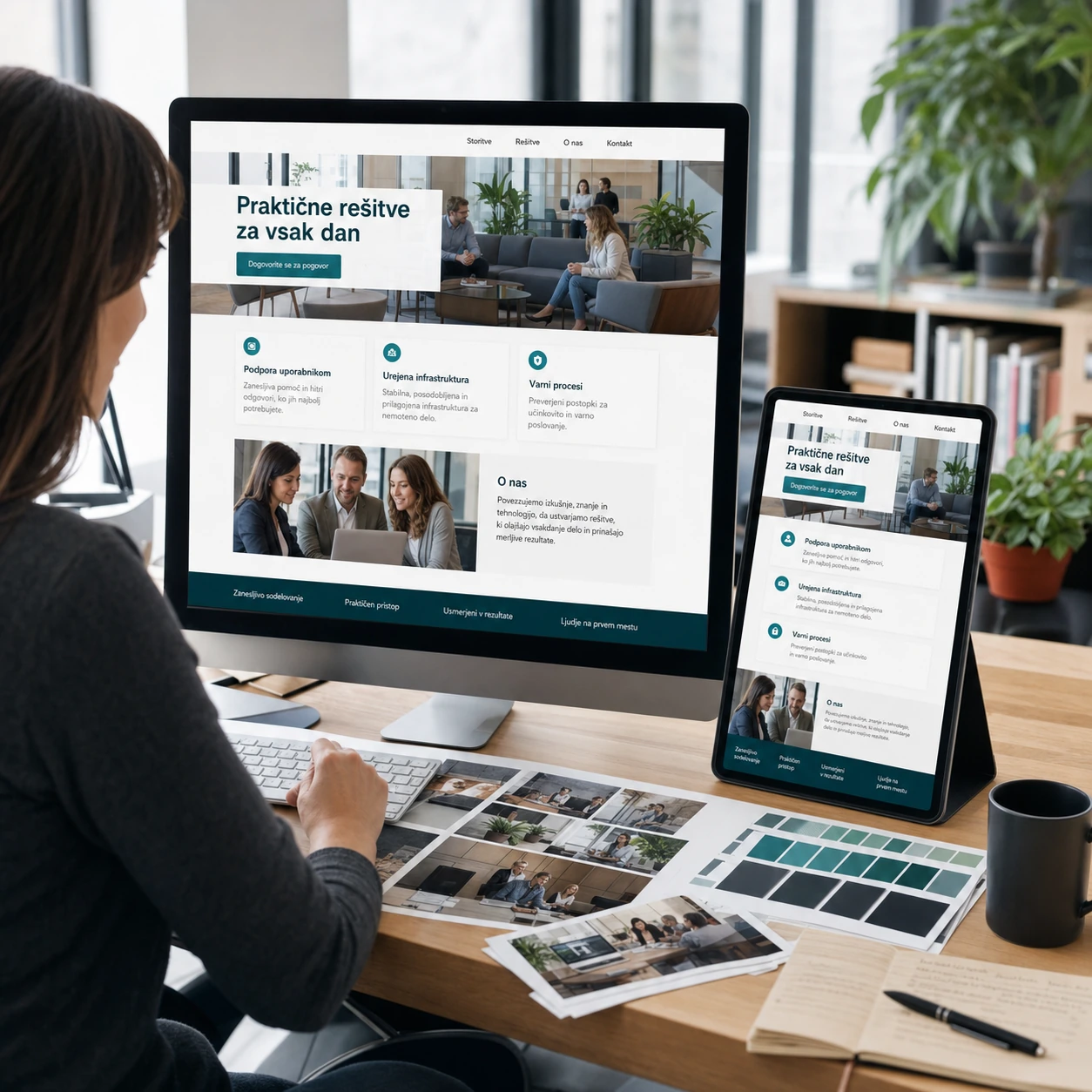
The elements of a useful public website
We build a set of components around your services, content and working processes rather than copying a template. Consistent typography, spacing, contrast and clear headings make the site understandable for visitors and straightforward to maintain.
A clear hero message and call to action
The first screen explains whom the solution is for, its benefits and where visitors should go next.
Services, solutions and benefits
Cards and content sections distinguish individual services while showing the wider business outcome.
Your approach, examples and FAQs
A clear process, answers to common questions and honest limits reduce uncertainty before visitors contact you.
Contact, registration or a meeting
Calls to action appear where visitors have enough information to decide, as well as in the footer.
Articles, documents and campaigns
Repeatable content types let your business build organic visibility while retaining a consistent site structure.
Readability and usability
We pay attention to heading hierarchy, contrast, image descriptions, visible form labels and keyboard usability.
A CMS should make work easier
After launch, your business should be able to update text, images, contacts, articles, offers and FAQs easily. We organise the CMS, reusable content templates and clear editorial roles. Joomla, WordPress or another system is selected according to purpose, integrations, team skills and maintenance costs.
Components can cover service pages, articles, documents, seasonal campaigns, galleries, catalogues, member areas and multilingual content. The aim is a quick, predictable way to make the changes your business actually needs, with sensible guidelines.
We prepare concise editor instructions and identify which changes can be published directly and which should be checked in staging first.
From a visit to a useful enquiry
A contact form can begin a sales process, register someone for training, request a quote or qualify a new customer. We give it a clear purpose, understandable fields, confirmation of the next step and the minimum necessary data collection.
Where needed, we connect forms to email, a CRM, a calendar, a newsletter system or another agreed process. We check where data goes, add spam protection and document integrations so that forms support your team rather than adding manual work.
A contact form with a clear purpose
Fields and confirmation messages help visitors describe their needs and give your team a better basis for the first response.
Events, workshops and materials
Registration journeys can connect to a calendar, confirmation, materials or the next communication step.
Connected to your processes
CRM, email, newsletters or internal systems are connected when the purpose is clear and responsibilities are documented.
Less spam and less unnecessary data
We protect forms against misuse and limit data collection and access to what is actually required.
Technical quality is part of delivery from the start
A successful site can be updated safely, recovered quickly and published predictably. Hosting, domains, HTTPS, access rights, staging, backups, monitoring and incident response are therefore considered during development. They support both the public website and the business process behind it.
Domains, DNS, hosting and HTTPS
We clarify responsibility for accounts, certificate renewal, DNS and form connections so that essential settings are documented and accessible.
Roles and MFA
Administrators, editors, developers and marketing staff need different permissions. We apply least-privilege access and review obsolete accounts.
Testing before publication
Important changes are checked on a test version or through an agreed procedure before they affect production visitors.
Backups and test recovery
We back up files, the database and important configuration, and where required verify that the site can be restored in a separate environment.
Availability and key functions
We monitor agreed areas such as availability, certificates, forms or integrations so that faults are detected earlier.
CMS, template and extensions
Regular update reviews reduce the risk of outdated components. Changes are coordinated with the site's actual condition and requirements.
Baseline settings and response
We review unnecessary components, security headers and procedures for containing the impact of a fault or incident.
Technical quality for visitors
Clear URLs, titles, internal links, images, caching and redirects create a useful foundation for visibility and usability.
Delivery in clear phases
We start by reviewing goals, the existing site, content, domain, hosting, access and integrations. Then we define the first phase, responsibilities, required materials and approvals. Redesigns receive particular attention to important URLs, redirects and SEO risks.
We then develop the structure or prototype, design components, implement the site, add content, test and launch. Before launch, we check mobile layouts, navigation, forms, essential SEO information, agreed integrations and technical foundations.
After launch, we hand over instructions, essential access and documentation. Remote collaboration is our usual approach; visits can be useful for workshops, meetings with several stakeholders or connections to local systems.
Goals, scope and starting point
We agree who the visitors are, what the site should achieve and what to keep or improve from the existing setup.
Content and components
We prepare the sitemap, priorities, user journeys and components for recurring content.
Design, CMS and features
We build responsive pages, forms, integrations, CMS templates and the technical foundations for reliable operation.
Testing, launch and support
We verify the result, organise documentation and agree a handover or ongoing maintenance.
A website that is easier to use and develop
A clearer presentation
Visitors understand your offer, benefits and next step more quickly, without searching through general descriptions.
An organised CMS
Your team can safely manage agreed content and knows when larger changes need testing.
A stronger foundation for SEO and performance
Structure, content, images, redirects and technical settings support future organic visibility and campaigns.
Predictable publishing and recovery
Access rights, staging, backups and monitoring reduce the risk of important changes or faults going unnoticed.
Clear responsibilities
Your business, agency, designer and technical provider know the agreed scope and who approves the next step.
Questions before starting a project
Yes. Delivery can include business structure, technical implementation, a CMS, components, forms, integrations, SEO foundations, launch and ongoing maintenance. We can also coordinate with a designer, photographer or marketing agency.
Yes. We first assess whether gradual improvements, technical cleanup or a new implementation make sense. We consider content, templates, extensions, performance, SEO risks, accessibility, hosting and maintenance costs.
Yes. We set up roles, components and short instructions so that your team can safely update agreed content types. Larger or higher-impact changes are checked in staging first.
By arrangement. We help organise hosting, domains, HTTPS, form connections and monitoring. Accounts and responsibilities remain documented with you or the agreed provider.
Yes, when the requirements are clearly defined. Before implementation, we agree user journeys, authentication or payments, data, integrations, maintenance and security requirements. Larger features receive a separate project scope.
We agree a handover or ongoing technical maintenance. This can include updates, backups, form checks, monitoring, editor support and planned improvements.
Tell us what kind of website you need
Tell us whether you need a new website, a redesign, additional functionality or help with an existing system. Include your business goal, audience, current technology and approximate deadline. We will suggest an initial review, a clear first phase or a project approach.
